






In the cold and under fire, science in Ukraine carries on
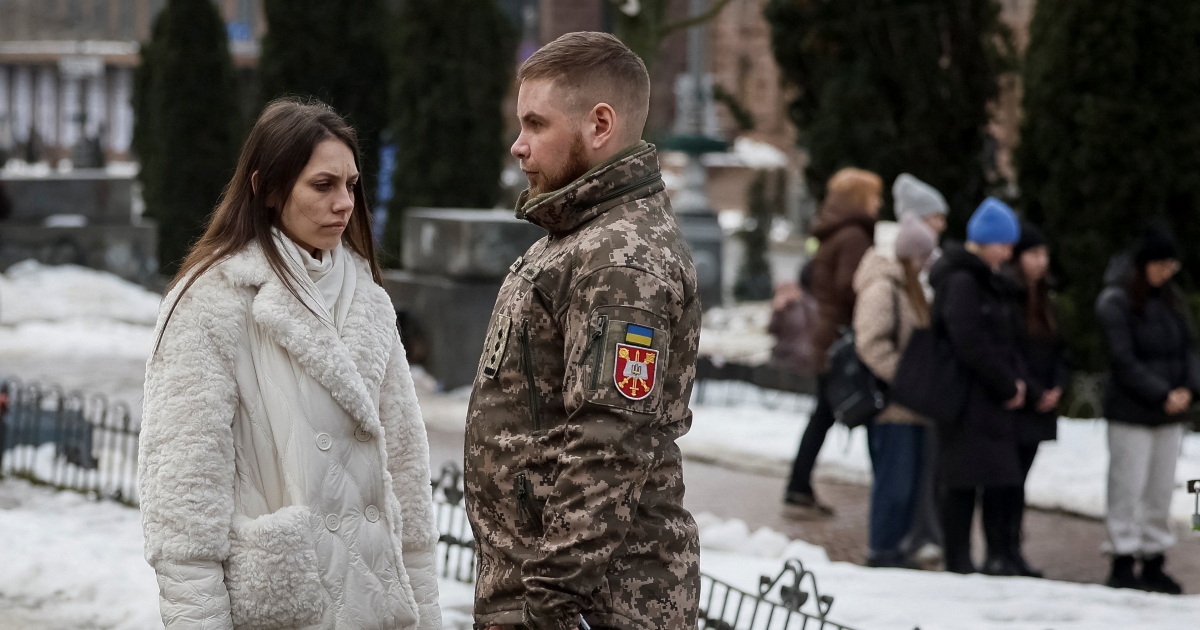
People observe a minute of silence to mark the fourth anniversary of Russia’s full-scale invasion of Ukraine, in Kyiv, Ukraine. REUTERS/Gleb Garanich
Kyiv is bitterly cold again. Electricity flickers on and off; heating is unreliable. In some parts of the institute, the temperature hovers just above freezing. “In my office it’s about two degrees,” Andrii Semenov says over a video call, still wearing his coat. “Here it’s maybe a little warmer.”
A theoretical physicist specialising in quantum optics, Semenov works at the Bogolyubov Institute for Theoretical Physics, part of the National Academy of Sciences of Ukraine, the country’s leading state research body. When temperatures recently fell to minus 20 °C, even minus 25 °C, entire days passed in darkness and cold. “I got sick with the flu,” he recalls. “It wasn’t the best experience of my life. But these days, it’s not the worst thing that can happen.”
When we first interviewed him four years ago, in the opening days of the invasion, the scientist appeared visibly shaken. “We didn’t know what to do. We didn’t expect anything like this,” he says. “Now we have four years of experience of living in wartime. It’s not pleasant — we would be better off without bombs — but at least we know what to do.”
He seems calmer now, at times even wry, displaying a dry humour far removed from the sombre, monochrome image often projected onto Ukraine. It is an irony rooted in a long post-Soviet tradition, where a smile has often been a form of survival and a sign of dignity.
The institute has not been directly hit, though nearby explosions have likely targeted infrastructure. Pipes have frozen and burst; parts of the building remain damaged. Still, work goes on. “We are researchers. Doing what we know how to do is the best contribution we can make.”
Semenov leads the Quantum Optics and Quantum Information Group, made up of six PhD students and a postdoctoral researcher, all Ukrainian. “They are highly competent and motivated — they are the ones who bring enthusiasm,” he says. Their work spans fundamental and applied research, from optics to metrology, using the principles of quantum mechanics — superposition and entanglement among them — to achieve unprecedented levels of sensitivity and precision in measurement.
Much of that work depends on heavy numerical simulations, and this is where the problems begin. During blackouts, laptops can run on battery power; more complex calculations require generators, which often fail in the coldest weather. International partners provide alternative computing resources, but in recent years Semenov has learned that complexity is not just a theoretical concept. “If things get worse, we’ll find another solution,” he says. “Everything is possible.”
Alongside leading his research group, he continues to teach. Before the invasion he lectured at Taras Shevchenko National University and contributed to master’s programmes at Kyiv Academic University. Since last year, he has also directed a bachelor’s programme in physics at the Kyiv School of Economics. “Having a lot of work is better than having none,” he says with a faint smile.
For now, Semenov has chosen to remain in Ukraine while his family lives abroad. With two children, the decision was unavoidable. “The apartment isn’t safe. Often there is no heating or electricity. The attacks are constant,” he explains. “I am grateful to the German government for hosting them. Without that, everything would be even more difficult.” Even so, living apart is hard.
Ukrainian science, he argues, was already struggling before the war, still shaped by a Soviet-era system in need of reform. Change is now even more urgent, though circumstances make it harder. Semenov sits on the scientific council of the newly established National Research Foundation of Ukraine, which distributes state funds for basic and applied research. The sums remain relatively modest, but the mechanisms are improving. Many calls for proposals are, inevitably, linked to military needs, and even researchers not directly engaged in defence may find themselves contributing through consultancy, collaboration, or training. “It’s normal,” Semenov says, declining to elaborate.
International collaborations continue and, in some cases, are deepening. In addition to bilateral programmes supported by European and US foundations, his group maintains long-standing ties with universities in Rostock, Nottingham, Paris-Sorbonne, and Padua. “There is interest in our work. They involve us in new research directions, and that helps a lot.”
The past winter has been harsh. Periodic promises of a swift end to the conflict surface and fade, but Semenov remains sceptical. He stresses that he is neither a politician nor a military expert, yet he believes the war has an existential character. “It is not just about taking territory. The aim is to destroy us completely. And yet Ukraine exists. The nation exists. The state exists. And it seeks ever deeper integration with Western institutions, starting with the European Union.”
A ceasefire may be possible; a stable peace, far less so. “As long as this regime remains in Russia, the war will continue,” he says. Then he smiles briefly and returns, for a moment, to his discipline. “As a quantum physicist, I can only say that the future is unpredictable. Who knows what will happen tomorrow?”
An open, indeterminate future — shaped by will, by ties and by relationships: the stubborn web of choices and connections that, for 1,461 days and counting, has kept Ukraine alive.


