





The River with Rights: The Māori lesson of Whanganui
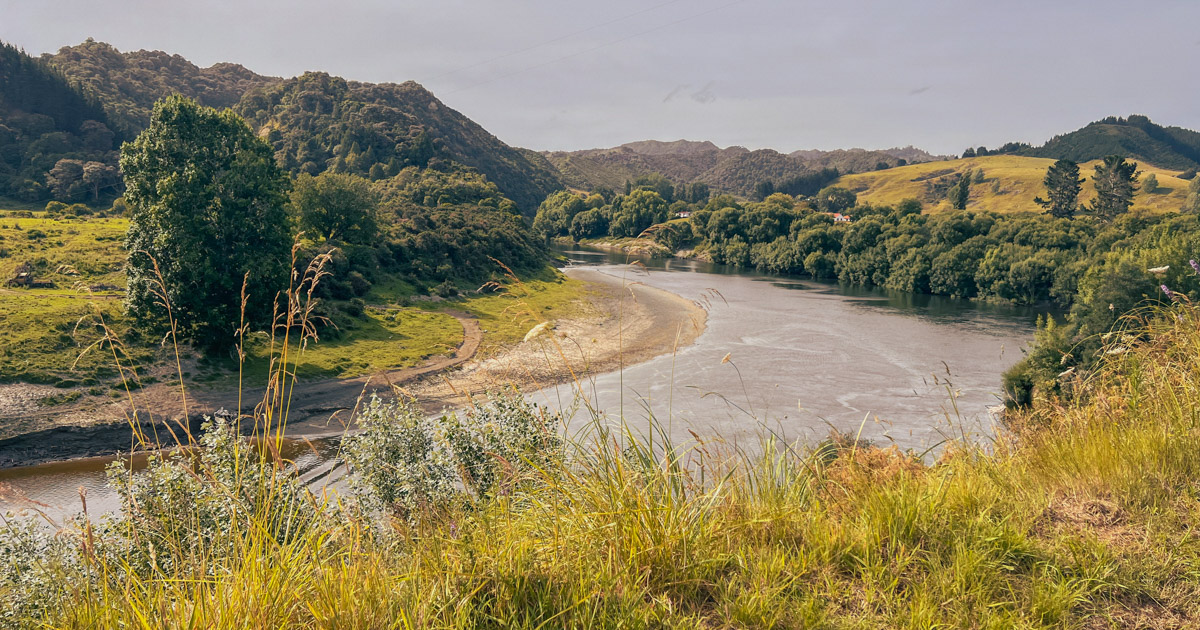
Whanganui river, New Zeland. Foto di Sara Segantin
“Ko au te awa, ko te awa ko au” — I am the river and the river is me.
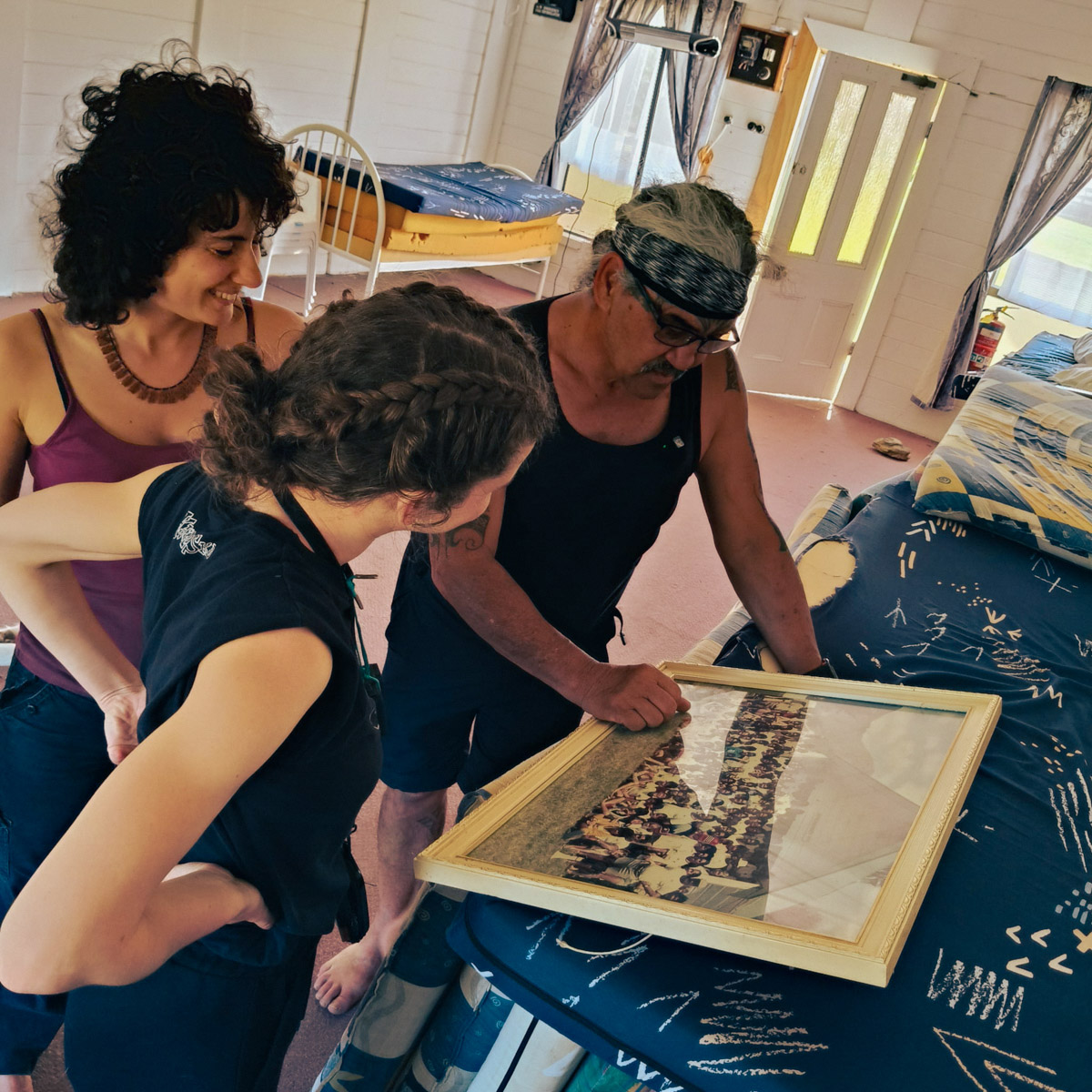
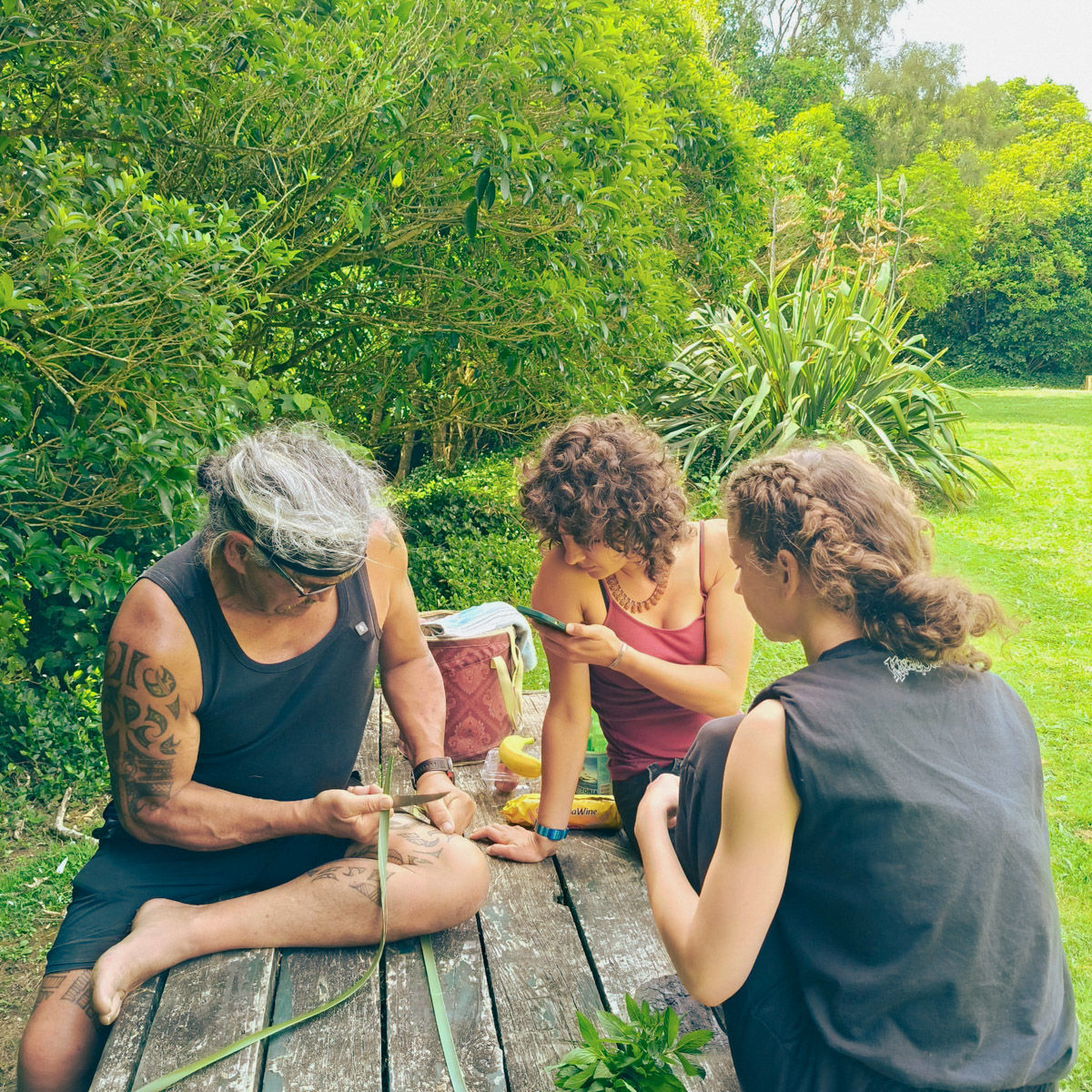
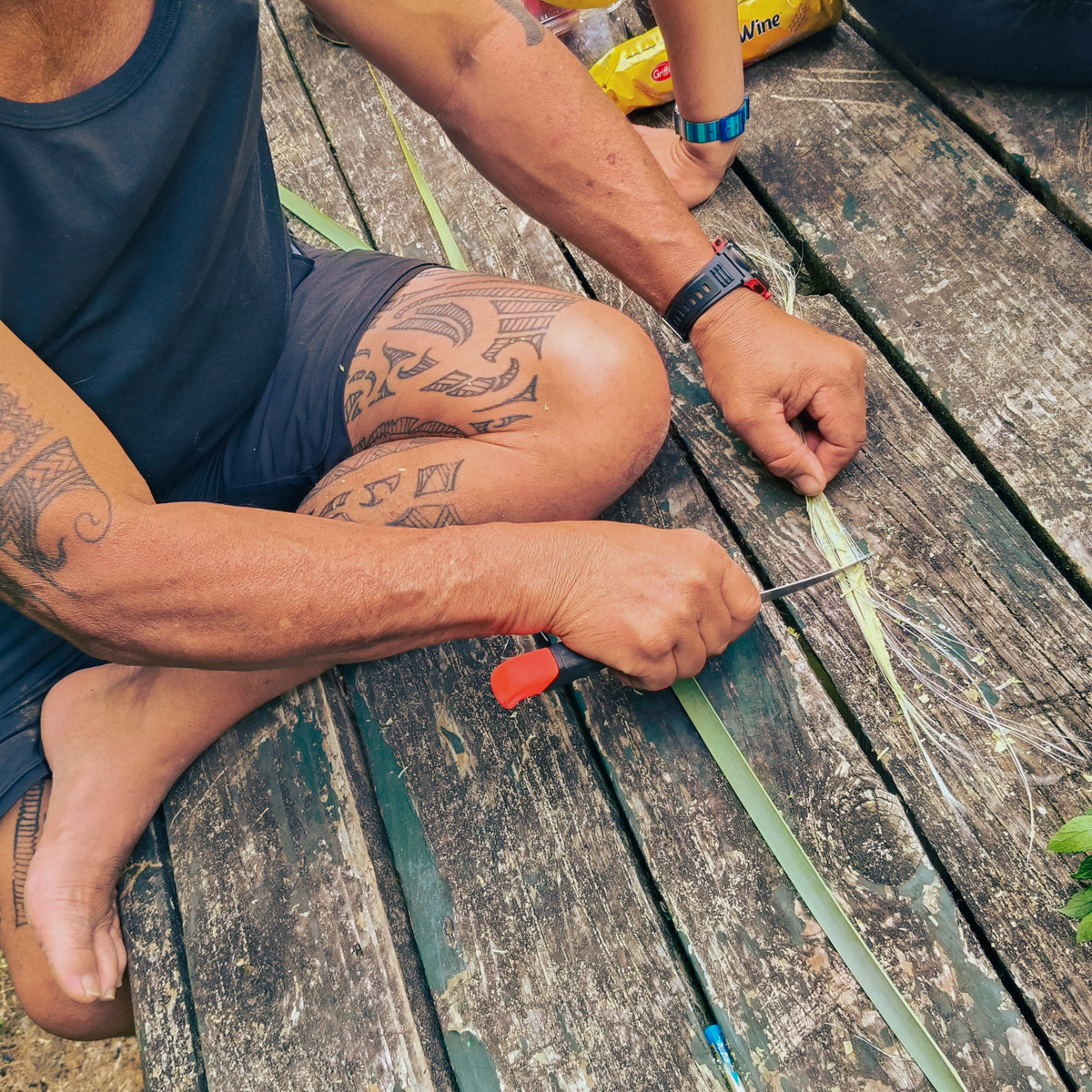
The phrase appears in large letters on the wooden wall of the Māori community house in Whanganui. The two-story building stands on a steep bank overlooking the river of the same name. Inside there are paddles of every kind, a large wooden statue, yellowed photographs, and images of canoes of many shapes and sizes. It is here that we meet Ned Tapa, one of the most well-known Māori leaders today. He is of modest height but powerfully built, with white hair tied under a black headband and a face marked by moko — the traditional tattoos that tell stories of genealogy and belonging.
On the table are small models of canoes from all over the world. In the basement, instead, there are real hulls: ultralight racing canoes and ancient waka that Ned recovers from vintage shops or rescues from restaurateurs ready to cut them in half to turn them into designer tables. “They wanted to saw this one to make a doorway,” he says, stroking the dark wood of a century-old canoe. “I saved it and brought it home. It needs to be restored and loved. It is an ancestor and it has its own spirit.”
For Ned, the canoe is not just an endless passion; it is a vehicle of identity. He repairs keels, crafts paddles, and navigates by the sun and the stars. He knows the moods of the river and the currents of the sea. “I am the river, the river is me.” It is not a poetic metaphor but a cosmological vision in which human beings and the environment are inseparable, bound by a moral and legal duty of care.
The river sacred to Ned is the Whanganui, one of the longest and most important rivers in New Zealand — Aotearoa in the Māori language, the Land of the Long White Cloud. It flows through the heart of the country, between ancient forests and deep gorges of the North Island. For the Māori people, and especially for the communities of the Whanganui Iwi who have always lived along its banks, it is a living being, an ancestor with whom their existence is intertwined through millennia-old spiritual bonds.


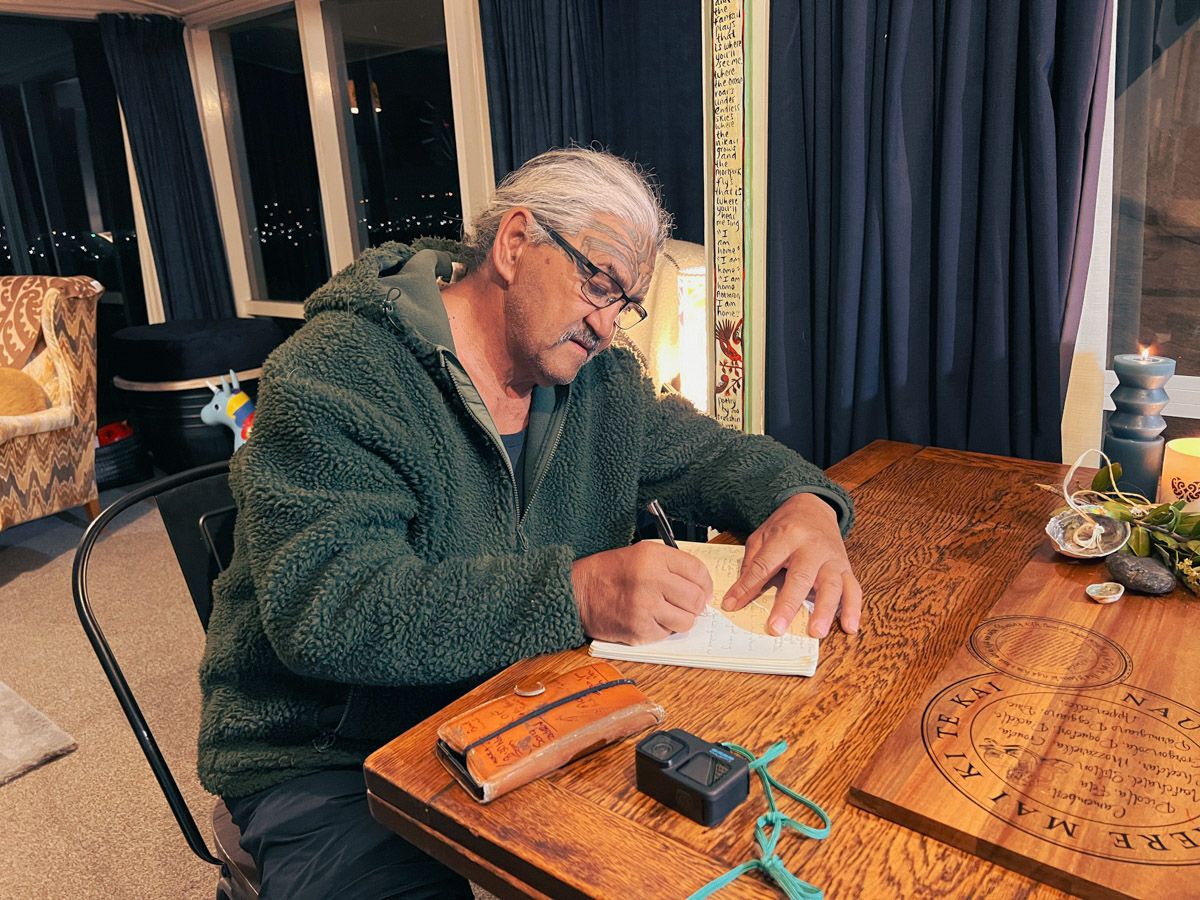
Ned Tapa. Foto di Sara Segantin
In 2017, New Zealand passed the Te Awa Tupua – Whanganui River Claims Settlement Act, declaring that the Whanganui River is a legal entity in its own right. It is the first case in the world of a river recognized as a legal subject with its own independent personality. The river must be respected not because it is a public resource useful to human beings, but for its intrinsic value, and it enjoys rights of its own. The law created the role of Te Pou Tupua, two representatives — one appointed by the state and one by the local iwi — tasked with speaking and acting on behalf of Whanganui. The judge established that any decision affecting the river must take into account its legal status, as Whanganui is “an indivisible and living whole that incorporates not only its physical components but also its spiritual and metaphysical significance.” A fund of 30 million New Zealand dollars was also established, a resource that institutions and communities can access by presenting projects dedicated to the health and wellbeing of the river.
The victory of Te Awa Tupua is a global milestone and a historic achievement for the recognition of Māori rights. In the following years, the Te Urewera National Park and Mount Taranaki Maunga were also recognized as entities with legal personality. However, despite the ongoing efforts of Ned and many other Indigenous leaders — who are always on the front lines of struggles for social and environmental justice — the political climate in New Zealand is currently very tense. The measures adopted by the present government have been criticized by human rights groups and by the United Nations, which have expressed concern about the potential weakening of Māori protections.


At the center of the debate lies the Treaty of Waitangi, signed in 1840 between the British Crown and more than 500 Māori rangatira. It is the founding document of modern New Zealand. Differences between the English version and the Māori-language version — which Māori activists argue were deliberately imprecise to allow colonial speculation — produced divergent interpretations regarding sovereignty and ownership, opening a wound that would mark more than a century of conflict.
In 2023, the new coalition government led by Christopher Luxon, with the support of ACT Party leader David Seymour, announced its intention to legally redefine the “principles of the Treaty,” arguing that it granted undeserved privileges to Māori and that it was therefore necessary to return to a formal equality of rights without ethnic distinctions. For many Māori organizations and numerous legal scholars, this represented an attempt to empty the Waitangi Act of its substantive meaning, reducing the instruments of co-governance, representation, and specific protections achieved through decades of negotiations.
In November 2024, tens of thousands of people took part in Hīkoi mō te Tiriti, a national march culminating in Wellington, attended by iwi leaders, activists, academics, and non-Māori citizens. Public pressure led Parliament to halt the bill. It was a symbolic victory, but also proof of how fragile the balance remains.
“They are dismantling the Treaty of Waitangi,” says Ned. “We fought for decades so that Māori language and culture would enter the schools, so that the health of our communities would be taken seriously. Now they want to go backward and they are cutting funding for services directed at our communities, especially those related to health.”
Ned also works in a hospital as a cultural mediator. “Western medicine is fragmented, discontinuous, disconnected,” he explains. “It treats the piece, not the relationship.” In the Māori worldview, health is the balance between physical, spiritual, family, and environmental dimensions. His work is to translate between two systems of knowledge. “You don’t save a life in a day. You save it along a journey.”
Without this mediation, many Māori simply would not enter hospitals. Distrust toward healthcare institutions stems from decades of discrimination, linguistic misunderstandings, and lack of respect for traditional practices. Inequalities remain stark: the life expectancy of Māori — today about 17% of New Zealand’s population — is on average about seven years lower than that of non-Māori, with higher rates of chronic disease, poverty, and crime. Without bridge figures, the risk is the abandonment of treatment, leading to further health and social marginalization. At the same time, Māori medical knowledge — which integrates spirituality, nutrition, and connection with the land — can contribute to more holistic and advanced models of health.
Together with his wife Rihi, Ned also supports young Māori involved in gangs, alcohol, and drugs. The wounds of colonialism are still deep and are reflected in a growing sense of disorientation among younger generations, making them easy victims of deviant paths. For decades Māori language and culture were discouraged and punished in schools, leading to a gradual disintegration of communities. Many were pushed toward urban outskirts, far from ancestral lands.
“People without identity,” says Ned. “Dishwasher was the most you could aspire to. We, who lived from air and land, in the kitchens of cities. No longer fully Māori, but not part of the other culture either.”
The response? The river.


“I take them by canoe to where their ancestors lived. I ask their surname and explain what it means. I show them the road home. Then they choose whether to walk it, but at least they know they can return.” The canoe becomes pedagogy, a reconstruction of belonging.
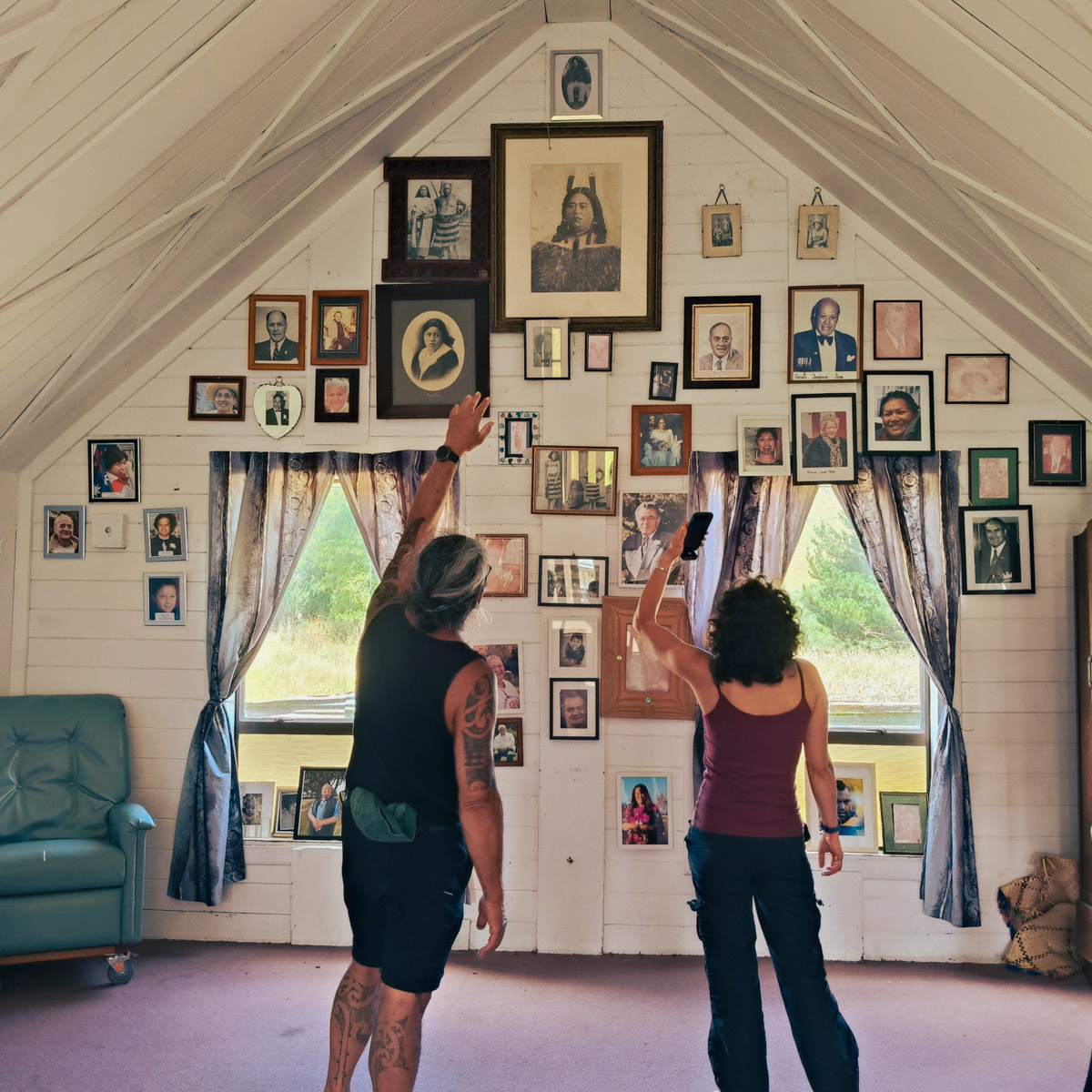
“In the past we died for causes that were not ours, hoping that would be enough to make the white people accept us.” Ned points to a photograph of his grandfather: “Italy. Monte Cassino.”
The reference is to the Battle of Monte Cassino, one of the fiercest battles of the Italian front during the Second World War. Māori soldiers, considered expendable troops by the British army, fought on the front lines with extraordinary courage. “They had treated us as inferior for decades,” Ned recounts. “We, foolishly, thought that by getting ourselves killed for the Crown we would gain respect. They called us heroes. On the graves of the dead.”
Ned returns to his playful spirit and cheerfully recounts Italian stories passed down from his grandparents. War aside, he says he likes Italians “because Italians have a bit of the Māori spirit — conviviality, good food…”
Today, he says, the instrument is no longer war but protest, political proposals, and the affirmation of identity. Not to separate, but to be recognized. Without unnecessary violence, without denying coexistence. But to what extent is the modern state willing to share power and recognize a plurality of legal visions? Ned wonders.
The challenge is immense, and for Ned Tapa it begins with his Whanganui. Giving concrete implementation to the rights of the river means guaranteeing resources, shared governance, and balance between agriculture, infrastructure, urban development, and ecosystem protection.
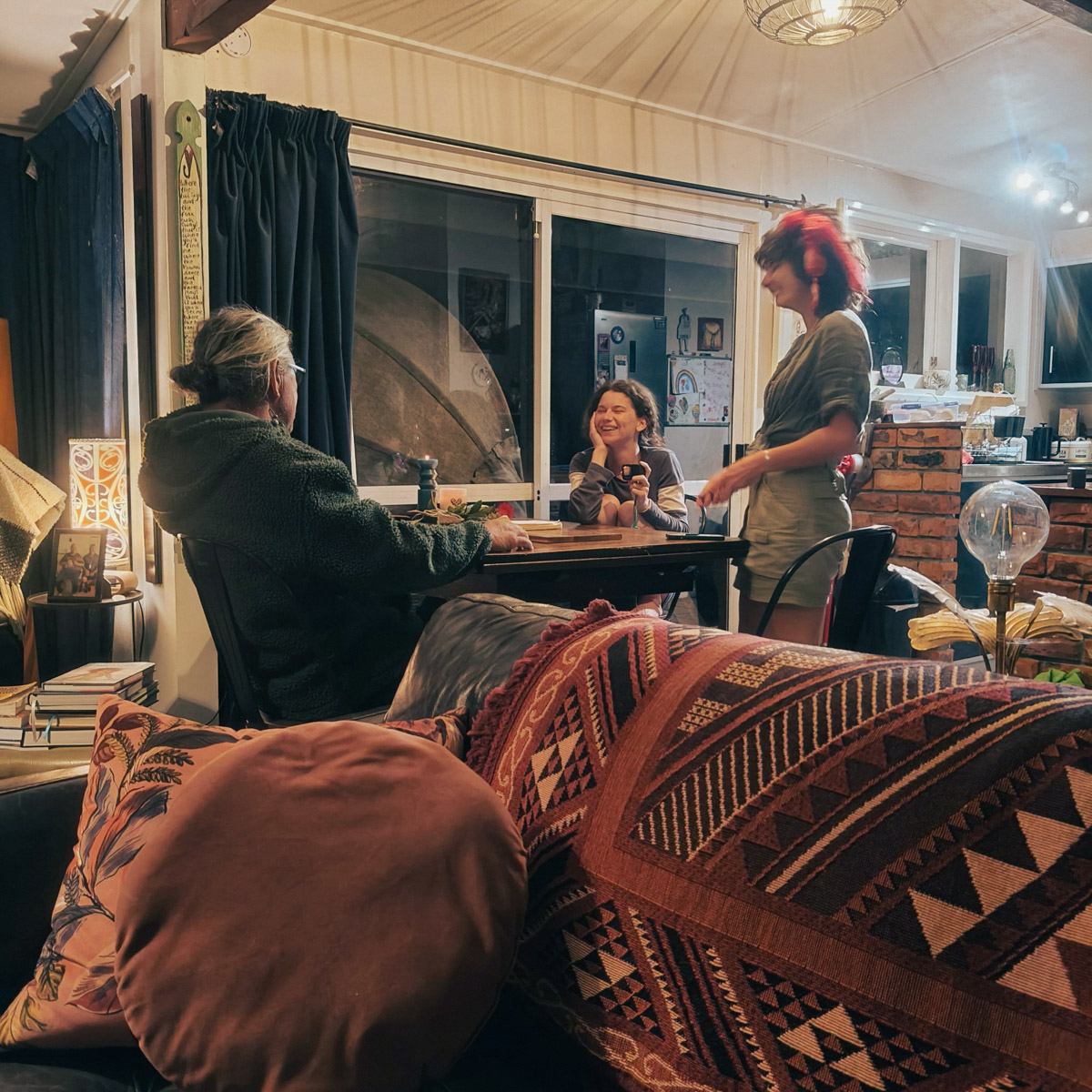
In the home of Ned and Rihi people speak of manaakitanga — care, respect, trust. Among ancestral tools and shared food emerges the playful utopia of “MAOtalia”: an imaginary state with Māori cosmology and Italian conviviality. “No dictators, no discrimination.”


Foto di Sara Segantin
We go back up the river and Ned stops in front of a dying sapling. He picks up a stick and rhythmically taps the trunk: “That’s how you wake it up,” he explains. “My grandmother always did it with fruit trees that were a bit stubborn.”
“Does it work?”
“I’ve always eaten excellent fruit.”
He laughs. Then he grows serious. “Every time a child is born, we plant a native tree.”
If MAOtalia is the dream, the word of reality is Aroha: love and mutual responsibility. It is law lived in practice. It is the meaning of Te Awa Tupua: not to possess nature, but to recognize ourselves as part of it.
At sunset, canoes glide across the Whanganui. The river flows, and with it the law, the silent memory, the eternal strength — gentle yet unstoppable — of the Māori people.
This article was originally written in another language. We edited the text with the support of an IA-based language tool.
Questo articolo è stato scritto originariamente in in un'altra lingua. Abbiamo rivisto il testo con il supporto di uno strumento linguistico IA.